One Assistant, Several Companies, Each in Its Own Voice
Getting an AI assistant to write is easy. Getting it to write like a specific company — and then like the next one — takes more than an instruction.
I've talked access and permissions to death lately, so I want to talk about something different: what it takes for an AI assistant to sound like the right company.
Several companies, several voices
In August, Cloudflare open-sourced Cloudflare OS, the AI workspace it built for its own staff. I deployed it for a holding company I help — a parent company with several operating companies underneath it — and connected it to Microsoft 365, the project boards, and web search.
The operating companies don't sound alike, and they shouldn't. One is a technology advisor for small and mid-size business owners. Its voice guide says to lead with the business outcome before the technology: "your front desk stops losing calls" comes before "hosted VoIP with ring groups." It stays calm about risk and ends with one clear next step. The other leads with the answer, then the evidence, then how confident it is — and would rather say "we can't verify that yet, here's what we'd need" than guess.
Left alone, an AI assistant writes in one voice: its own. It's fluent, upbeat, and generic, and it will happily describe both companies as delivering seamless, cutting-edge solutions. That default is the thing to fix.
Each brand in one place
Each company's colors, fonts, logos, voice guide, and Office templates live in one place the assistant can load. The workspace instructions tell it to load the brand before it writes anything for that company, and to write in that brand's voice.
That part is still an instruction, and instructions mostly work. The next part doesn't depend on them.
A check that isn't another opinion
Before any draft is shown, the instructions require a copy check. The check itself isn't a second AI grading the first — it's a fixed set of rules kept in version control and applied the same way every time:
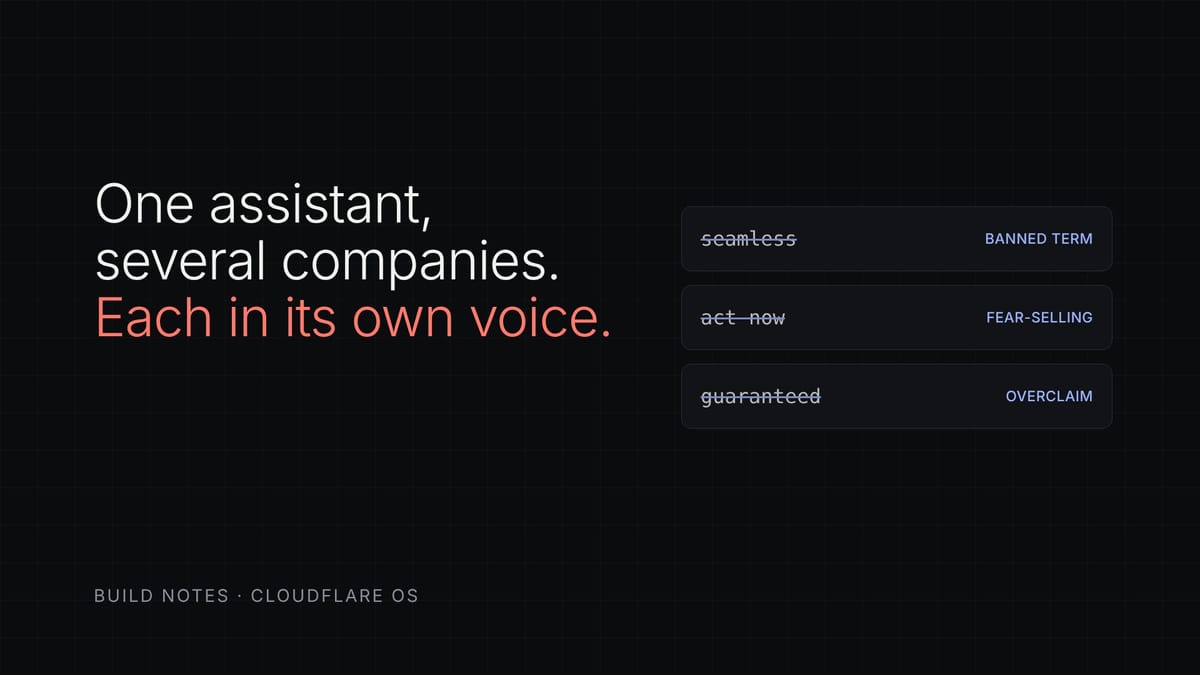
- Brochure vocabulary. Seamless, cutting-edge, best-in-class, game-changing, synergy, revolutionary, and the rest.
- Fear-selling. "Act now," "before it's too late," "hackers are targeting."
- Overclaims. Guarantees, "100% uptime," "zero risk."
- Client names.
- Acronym soup. Too many unexplained acronyms per hundred words, and more than one exclamation point.
- Each brand's common misspellings of its own name.
When something trips, it comes back with the excerpt and a fix — for "seamless," replace it with a plain, specific statement of what it does for the reader. The voice guide's own example: "Leverage our cutting-edge, best-in-class managed IT solutions" becomes "We keep your network, phones, and computers running, and we tell you plainly what needs attention."
Because the rules live in one file, changing the voice is a reviewed edit, not a new prompt someone has to remember to paste.
Files that can't come out off-brand
Ask for a Word document or a PowerPoint deck and it's built from that company's official template. It doesn't approximate the look — it uses the template's own slide layouts, styles, logo, and footer, and only the words change.
Here the copy check isn't an instruction at all. It's in the code that builds the file: if the words fail it, the file isn't made, and the assistant gets the list of what to fix. I asked it for a deck, approved the card, and it was sitting in OneDrive in the brand's template.
A template controls how a document looks. It doesn't stop the words on it from sounding like everyone else's. You need both.
Client work stays out
I also do consulting work, and those clients' email and files sit in the same inbox as everything else. Client mail, meetings, files, and projects are filtered out — by address, name, and folder — before the assistant ever gets them. Part of sounding like the right company is never borrowing from someone else's.
The short version
Getting an AI assistant to write is the easy part. Getting it to write like a specific company — and then like the next one, without the two blurring together — is the work. Instructions get you most of the way. The rest is a fixed check, the real templates, and a file that doesn't exist until the words pass.